
A ConsultCK Research Briefing for Indian MBBS Students, Interns, Graduates, IMGs and Parents Written and Reviewed by Chirag Khutia, Founder & Principal Counselor, ConsultCK
But USMLE Still Has No Exception. Why USMLE Aspirants Should Still Prepare for NEET PG in Parallel
In September 2025, the American Board of Internal Medicine (ABIM) finalised a pilot program known as the Special Consideration Pathway E informally called the “ABIM Pilot Pathway.” It allows a narrow group of internationally trained physicians who complete an ACGME-accredited U.S. subspecialty fellowship as an “exceptionally qualified candidate” to sit the Internal Medicine Certification Exam without repeating a full three-year U.S. internal medicine residency. As of March 2026, ABIM reported that more than 150 physicians had become eligible under this route.
For Indian MBBS graduates and their families, this is genuinely encouraging news. It signals that U.S. medical boards are actively looking for ways to recognise strong international training at a time of documented, worsening physician shortages. But this article’s central message is a caution, not a celebration: Pathway E does not remove, reduce, or create any exception to the USMLE requirement. Every route discussed in this article the ABIM pilot, the American Board of Radiology’s IMG Alternate Pathway, and the American Board of Orthopaedic Surgery’s academic pathway still sits downstream of ECFMG certification, and ECFMG certification still requires passing USMLE Step 1 and Step 2 CK, with Step 3 explicitly recommended or required in most of these routes. There is no version of this story where USMLE becomes optional.
ConsultCK’s recommendation, unchanged by this development, is that Indian MBBS students seriously considering the United States should prepare for USMLE and NEET PG in parallel wherever feasible not because either exam guarantees success, but because career optionality is the single most reliable form of risk management available to a young doctor today.
What Just Happened: The ABIM Pilot Pathway Explained
On 1 July 2026, Indian medical media began reporting widely on a development that had, in fact, been finalised by ABIM in September 2025: a pilot certification route formally called Special Consideration Pathway E. It is administered by the American Board of Internal Medicine under its long-standing “candidates for special consideration” policy framework, which already included an academic-faculty route (Pathway A) before Pathway E was added.
1.1 Who Is Eligible
To be considered under Pathway E, a candidate must, cumulatively:
- Have completed three years of verified graduate medical education in internal medicine outside the United States or Canada.
- Have been accepted into an ACGME-accredited U.S. subspecialty fellowship either as an “exceptionally qualified candidate” under ACGME Common Program Requirements (Fellowship, Section III.A.1.c / 3.2.b), or as a graduate of an ACGME-International (ACGME-I) accredited residency program.
- Satisfactorily complete all required subspecialty fellowship training, attested by the program director through ABIM’s FasTrack Clinical Competence Evaluation System.
- Hold a valid, unrestricted, and unchallenged medical license to practice in the U.S., its territories, or Canada at the time of application.
- Hold a valid ECFMG certificate.
Physicians who completed their U.S. fellowship any time since July 1, 2016 are retroactively eligible to apply. Once approved, the candidate registers for the Internal Medicine Certification Exam through the ABIM Physician Portal during open registration windows, and if they pass becomes eligible to sit the relevant subspecialty certification exam as well.
1.2 What “Exceptionally Qualified Candidate” Actually Means
This is not a self-declared label. Under ACGME’s Common Program Requirements for Fellowship, the designation is assigned by the fellowship program director, in consultation with the fellowship selection committee and the institution’s Designated Institutional Official and GME Committee, before the candidate is even accepted into the fellowship. It typically reflects demonstrated clinical excellence relative to peers, combined with evidence such as additional clinical or research training, scholarly output, or leadership shown during or after residency. There is no post-fellowship re-assessment of “exceptional” status — the bar is set, and evaluated, entirely at the point of fellowship entry.
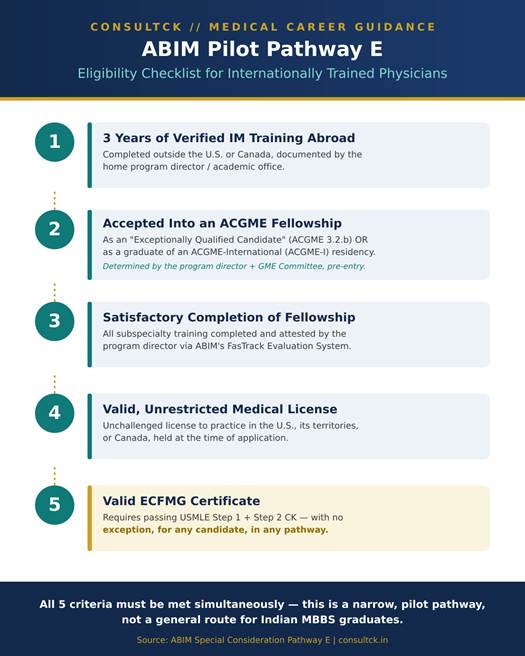
Infographic 1. ABIM Pathway E eligibility checklist all 5 criteria apply cumulatively.
| Did You Know? Infectious diseases fellowships have so far produced the largest share of Pathway E participants, according to reporting cited by the Infectious Diseases Society of America, likely reflecting historically softer U.S. Match competition and stronger demand for IMGs in that subspecialty. |
1.3 Why This Is Significant and Where the Limits Are
The significance lies in what the pathway removes: for a very small, highly credentialed group of IMGs who have already reached a U.S. fellowship through the ACGME-International route or an “exceptionally qualified” determination, it removes the need to separately repeat a full three-year U.S. internal medicine residency purely to become board-certifiable. The American Society of Nephrology, in its published commentary on the policy, noted that this expands career options for internationally trained physicians without altering the assessment of clinical competence that already occurs during fellowship.
The limits are equally important and are frequently glossed over in social media summaries. ABIM certification does not by itself grant a medical license. Licensure remains a state-by-state matter, and roughly half of U.S. states still require candidates to complete a minimum period of ACGME-accredited residency training commonly two to three years for unrestricted licensure, regardless of board certification status. A physician could, in principle, pass the Internal Medicine Certification Exam under Pathway E and still be unable to obtain a full license in a state with stricter residency-based licensure rules. This is a pilot, not a permanent policy: ABIM has stated it will monitor board pass rates and outcomes before deciding whether to expand, modify, or discontinue the pathway.
The ACGME Fellowship Requirement Behind the Pathway
Pathway E only exists because of a prior ACGME policy change embedded in the Common Program Requirements for Fellowship, which created formal room for programs to accept an “exceptionally qualified candidate” who has not completed ACGME-accredited residency, provided the program director and institutional GME Committee formally evaluate and document that qualification before matriculation. In plain terms: ACGME opened the fellowship door for a specific category of outstanding international residency graduates first; ABIM’s Pathway E is the certification-side response that lets some of those fellows sit boards afterward without redoing residency.
This is a narrow, competency-gated exception at the fellowship-entry stage it is not a general statement that ACGME fellowships are now open to any IMG without U.S. residency. The overwhelming majority of ACGME fellowship positions in the United States are still filled by physicians who completed ACGME-accredited U.S. residency training first.
Not an Isolated Case: Similar Alternate Pathways Elsewhere in U.S. Medicine
Indian families often assume the ABIM pilot is a one-off. It isn’t. Other U.S. specialty boards have run comparable and in some cases considerably older alternate pathways for internationally trained physicians. Understanding them side by side helps put the ABIM pilot in proper context.
Radiology: The ABR International Medical Graduate Alternate Pathway
The American Board of Radiology (ABR) has offered an IMG Alternate Pathway for diagnostic radiology for many years, revised several times between 2022 and 2025 to increase flexibility. Under this route, a physician who completed a diagnostic radiology residency of at least three years outside the U.S. or Canada, and who is qualified to practice radiology independently in that country, can complete four years of U.S. fellowship or faculty-level training at a single sponsoring institution and then sit the ABR certifying exams. A parallel two-year IR/DR pathway exists for those who have already completed the DR pathway.
Crucially, the ABR’s own published prerequisites are explicit that successful completion of all three USMLE steps is required before an applicant can even be considered for the pathway, along with a valid ECFMG certificate or Licentiate of the Medical Council of Canada. This is the clearest evidence available that alternate certification pathways in U.S. medicine are built on top of USMLE, not instead of it.
Orthopaedic Surgery: The ABOS Academic Pathway
The American Board of Orthopaedic Surgery (ABOS) also maintains an alternate route, but it is far more restrictive than either the ABIM or ABR pathways. It is designed for orthopaedic surgeons who received their graduate medical education outside the U.S. or Canada and who have gone on to independently practice for at least five years in the United States while serving as full-time academic teaching faculty in a single ACGME-accredited orthopaedic residency program, reaching the rank of Associate Professor or higher. This is not an early-career or fellowship-entry pathway; it is a late-career academic recognition route, and the American Academy of Orthopaedic Surgeons (AAOS) is clear on its own IMG information page that the standard route into U.S. orthopaedic practice for IMGs still runs through USMLE Steps 1, 2, and 3 and ACGME residency.
Table 1. Alternate U.S. Certification Pathways for IMGs at a Glance
| Pathway | Board | Core Requirement | USMLE Requirement | Realistic Scale |
| Standard Residency Route | ABMS boards generally | Full ACGME residency in the U.S. | Steps 1, 2 CK, 3 — no exception | Tens of thousands of IMGs annually |
| Pilot Pathway E | ABIM (Internal Medicine) | 3 yrs IM training abroad + ACGME fellowship as EQC or ACGME-I graduate | Still required for ECFMG certification, a prerequisite | ~150 eligible as of March 2026 (pilot) |
| IMG Alternate Pathway | ABR (Radiology) | 3+ yrs DR residency abroad + 4 yrs U.S. fellowship/faculty training | All 3 Steps explicitly required before consideration | Small; institution-dependent |
| Academic Pathway | ABOS (Orthopaedic Surgery) | 5+ yrs independent U.S. academic practice as Associate Professor+ | Steps required to reach faculty status in the first place | Very small; late-career only |
Does This Mean USMLE Is Becoming Easier? Noand There Is No Exception
| Key Takeaway No pathway described in this article ABIM Pilot Pathway E, the ABR IMG Alternate Pathway, or the ABOS Academic Pathway removes the USMLE requirement. Every one of them requires ECFMG certification (built on USMLE Step 1 and Step 2 CK) as a prerequisite, and most explicitly reference USMLE Step 3 as well. There is no exception for USMLE anywhere in this policy landscape. |
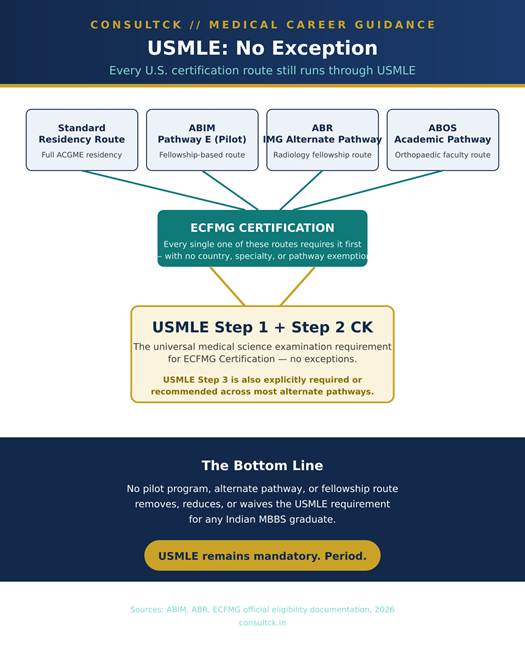
Infographic 2. Every certification route funnels through ECFMG and USMLE.
It is worth stating plainly, because the framing in some Indian media coverage risks being misread: none of this represents U.S. medicine lowering its entry bar. ECFMG’s own 2026 eligibility documentation confirms that to satisfy the medical science examination requirement for ECFMG Certification, IMGs must pass Step 1 and Step 2 Clinical Knowledge of the USMLE, with no carve-out for any specialty pathway, country of training, or fellowship status. The ABR alternate pathway goes further, stating outright that successful completion of all three USMLE steps is required before an applicant may even be considered. Even ABIM’s own pilot, which is the most permissive of the three discussed here, still requires a valid ECFMG certificate which itself cannot exist without USMLE.
What is actually happening is narrower and more structural: the U.S. graduate medical education system is evolving how it recognises non-U.S. residency training at the fellowship-entry and certification stage, in specific specialties where documented workforce need is acute. USMLE remains the single, universal gateway exam standard for every category of international medical graduate seeking to enter U.S. graduate medical training or certification, with no version, waiver, or substitute currently available or proposed.
Myth vs Fact
| Myth | Fact |
| “The new ABIM pathway means IMGs can skip USMLE.” | False. ECFMG certification, a prerequisite for Pathway E, requires USMLE Step 1 and Step 2 CK with no exceptions. |
| “This pathway is open to all Indian MBBS graduates.” | False. It applies only to physicians already inside an ACGME-accredited U.S. fellowship as an “exceptionally qualified candidate” or ACGME-International graduate — a very small population. |
| “Board certification under this pathway means a full U.S. medical license.” | False. Licensure is separate and state-specific; many states still require a minimum period of ACGME-accredited residency for unrestricted licensure. |
| “This is now a permanent, guaranteed route.” | False. ABIM has explicitly designated this a pilot subject to ongoing review of outcomes and pass rates. |
5. Why Alternate Pathways Are Emerging: The U.S. Physician Shortage in Numbers
Pathways like ABIM’s pilot do not emerge from goodwill alone; they emerge from measurable workforce pressure. The Association of American Medical Colleges (AAMC), in its most recent update, projects a national physician shortage of between 13,500 and 86,000 physicians by 2036, including a shortfall of 20,200 to 40,400 primary care physicians and 10,100 to 19,900 surgical specialists. The Health Resources and Services Administration’s National Center for Health Workforce Analysis, using a separate model published in December 2025, projects an even larger shortfall : 124,180 full-time-equivalent physicians by 2027, rising toward 187,130 by 2037, with primary care and rural, non-metro regions affected most severely.
These shortages are already visible in access data, not just projections: the number of federally designated primary care Health Professional Shortage Areas rose from 7,718 in 2024 to 8,467 in 2025 — a roughly 9.7% jump in a single year according to HRSA data compiled in recent workforce analyses.
Table 2. U.S. Physician Shortage Projections (Selected Sources)
| Source | Projection Horizon | Total Shortage Estimate | Primary Care Component |
| AAMC, “Complexities of Physician Supply and Demand” (2024 update) | By 2036 | 13,500 – 86,000 physicians | 20,200 – 40,400 physicians |
| HRSA / NCHWA Physician Projections (Dec. 2025) | 2027 / 2032 / 2037 | 124,180 / 167,030 / 187,130 FTE physicians | 68,020 primary care FTEs by 2036 |
| AAMC (2022 update, IHS study) | By 2025 | 61,700 – 94,700 physicians | 14,900 – 35,600 physicians |
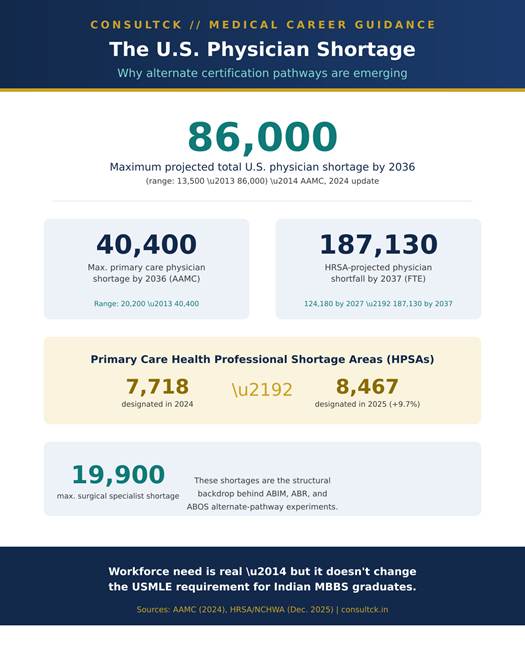
Infographic 3. U.S. physician shortage projections at a glance.
This is the backdrop against which specialty boards and ACGME are experimenting with narrow, competency-based recognition of international training: not as a policy of convenience, but as one of several responses to a workforce gap that domestic U.S. medical school output alone is not projected to close.
6. IMG Participation and NRMP Match Trends
International medical graduates already form a substantial and growing share of the U.S. physician pipeline. The National Resident Matching Program’s 2026 Main Residency Match reporting notes that participation by non-U.S.-citizen IMGs continued to grow, with active applicants increasing 51.9% between 2022 and 2026 one of the fastest-growing applicant categories in the Match. The 2026 Match overall recorded a 99.3% fill rate for participating positions, with Family Medicine offering 5,491 positions and Psychiatry expanding to 2,516 positions at a 97.4% fill rate two specialties that have historically drawn strong IMG participation.
India remains one of the largest single source countries for IMGs pursuing U.S. residency, alongside the Caribbean-trained U.S.-citizen IMG pool and Pakistan. NRMP’s published Match-by-specialty-and-state tables distinguish U.S.-citizen IMGs from non-U.S.-citizen IMGs in every specialty and state breakdown, reflecting how granular this data has become as the applicant pool diversifies.
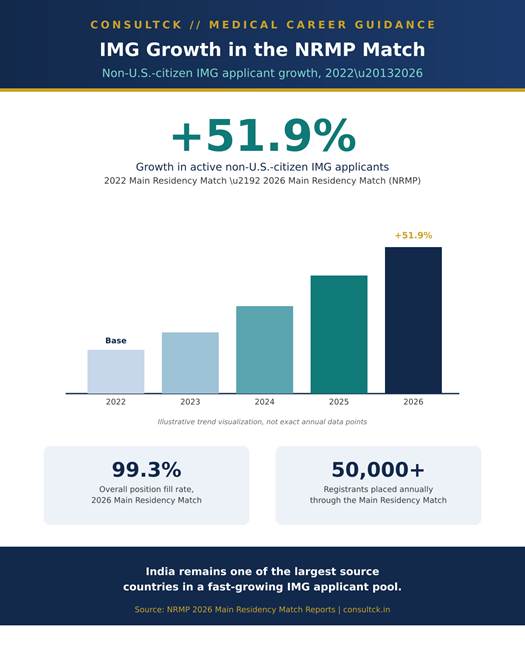
Infographic 4. Non-U.S.-citizen IMG applicant growth in the NRMP Match, 2022–2026.
| Did You Know? The NRMP has run its Main Residency Match since 1953, and its Specialties Matching Service now covers 22 separate fellowship Matches across more than 80 subspecialties the same infrastructure IMGs will eventually need to navigate even after a pathway like ABIM’s Pathway E, since fellowship entry itself is highly competitive. |
7. Advantages, Limitations, Unknowns, and Risks of Pathway E
Advantages
- Removes duplicative full U.S. residency for a defined group of physicians who have already demonstrated competence through a completed ACGME fellowship.
- Retroactive eligibility to 2016 acknowledges existing IMGs already working within U.S. GME rather than only future applicants.
- Signals growing institutional willingness among ABMS-member boards to formally recognise strong international residency training in defined circumstances.
Limitations
- Applies only within ABIM’s internal medicine and subspecialty disciplines — it is not a general IMG pathway across all specialties.
- “Exceptionally qualified” status is determined at the discretion of individual fellowship programs, with no standardised national test or score threshold.
- Board certification does not equal state medical licensure; many states still require ACGME residency time for full licensure regardless of board status.
Unknowns
- Long-term board pass rates for Pathway E candidates have not yet been published; the American Society of Nephrology has specifically called for close monitoring of this data.
- Whether ABIM will expand, narrow, or discontinue the pilot after its review period remains undecided.
Risks for Students Who Misread This News
- Treating this as a shortcut around USMLE or full residency, when it is neither.
- Assuming eligibility applies broadly, when in practice it applies to a small, already highly credentialed subset of physicians who reached a U.S. fellowship through an unusually difficult route.
- Deprioritising NEET PG or other domestic options on the strength of a pilot program that could be modified at any point.
8. Who Should Realistically Consider This Pathway
Pathway E is relevant to a very specific profile: a physician who has already completed at least three years of internal medicine residency abroad, has already been accepted into and is completing (or has completed since 2016) an ACGME-accredited U.S. subspecialty fellowship, and has already been recognised by that fellowship program as an “exceptionally qualified candidate” or entered via an ACGME-International residency. For a current Indian MBBS student or intern who has not yet begun USMLE, this pathway is not a near-term consideration — it is, at most, a data point that reinforces why sustained excellence throughout training matters, because “exceptionally qualified” status is earned years before Pathway E ever becomes relevant.
9. Why ConsultCK Recommends Building Multiple Career Pathways
This is the section that matters most for the Indian MBBS student reading this article today, well before any of the pathways above become personally relevant. ConsultCK’s long-standing position, reinforced rather than changed by the ABIM pilot, is that career resilience in medicine comes from optionality, not from betting an entire career plan on a single examination or a single country.
In practice, that means building strength across several dimensions simultaneously, to the extent time and resources allow:
- USMLE preparation — Steps 1 and 2 CK, approached as a genuine knowledge foundation rather than a checkbox.
- NEET PG preparation — kept alive in parallel wherever feasible, preserving a credible domestic postgraduate route.
- Research and publications — even modest, well-documented research strengthens both U.S. fellowship applications and Indian PG/DNB profiles.
- A structured, honestly-written CV — built incrementally through internship and early career, not assembled retroactively under deadline pressure.
- Clinical electives and observerships — where accessible, to build both competence and letters of recommendation.
- Professional networking and mentorship — sustained relationships with seniors and mentors who can speak credibly to a candidate’s competence, which is precisely the kind of evidence that underlies “exceptionally qualified” determinations.
- Leadership and communication skills — increasingly weighted by residency and fellowship selection committees, and directly relevant to OET Medicine and interview performance.
- Long-term mentorship — periodic, honest reassessment of the plan rather than a single decision made once in Grade 12 or MBBS Year 1.
None of this is offered as a promise of outcome. Match rates, fellowship acceptance, and pilot-pathway eligibility all remain competitive and, in places, discretionary. What parallel preparation offers is not a guarantee it is the ability to redirect toward whichever door opens first, rather than discovering at year four or five that the single door chosen years earlier has narrowed or closed.
Expert Commentary
| “Medicine is becoming increasingly global, and pathways like ABIM’s pilot are a reminder that global recognition is being built specialty by specialty, exception by exception not through any single shortcut. The students who will succeed over the next decade are those who prepare for multiple career pathways rather than betting everything on one examination. Preparing simultaneously for USMLE and NEET PG is not about choosing one country over another; it is about keeping every meaningful opportunity open until your career direction becomes genuinely clear.” — Chirag Khutia, Founder & Principal Counselor, ConsultCK |
This is expert commentary and professional opinion offered by Chirag Khutia and ConsultCK, based on 18 years of medical career counselling experience — it should be read as informed guidance, not as independently verified fact about any individual’s likely outcome.
10. Career Flow at a Glance
Flowchart A — The Traditional Certification Route
MBBS (India) → ECFMG Certification (USMLE Step 1 + Step 2 CK + OET Medicine) → USMLE Step 3 → ACGME Residency Match (NRMP) → Board Certification (ABIM / ABR / ABOS, standard route) → Optional ACGME Fellowship → Subspecialty Board Certification.
Flowchart B — Where Pathway E Fits (Applies to a Narrow Subset Only)
MBBS (India) → 3 Years IM Residency Abroad → ECFMG Certification (USMLE Steps 1 & 2 CK, still required) → Entry into ACGME Fellowship as “Exceptionally Qualified Candidate” or via ACGME-International Residency → Fellowship Completion (FasTrack Attestation) → ABIM Special Consideration Pathway E Application → Internal Medicine Certification Exam → Subspecialty Certification Exam.
Flowchart C — The ConsultCK-Recommended Parallel Preparation Model
MBBS (India, Years 1–5) → Parallel Foundation Building: USMLE Step 1/2 CK Preparation + NEET PG Preparation + Research/Publications + Clinical Exposure → Internship → Decision Point With Multiple Live Options: NEET PG / DNB in India, USMLE Match Abroad, or Other International Pathways (UK PLAB/UKMLA, Australia AMC, etc.) → Career Direction Chosen From Strength, Not Default.
11. Frequently Asked Questions
Q. Does the ABIM Pilot Pathway mean I can skip USMLE?
A. No. ECFMG certification is a prerequisite for Pathway E, and ECFMG certification requires passing USMLE Step 1 and Step 2 Clinical Knowledge. There is no exception for USMLE anywhere in this pathway.
Q. Who exactly is eligible for Pathway E?
A. Physicians who completed three years of internal medicine training abroad and were accepted into an ACGME-accredited U.S. subspecialty fellowship as an “exceptionally qualified candidate” or as a graduate of an ACGME-International residency, and who have satisfactorily completed that fellowship.
Q. Can a current MBBS student in India apply for this pathway right now?
A. No. The pathway is only relevant after completing residency abroad and being accepted into a U.S. ACGME fellowship steps that themselves require ECFMG certification and USMLE first.
Q. Does passing Pathway E’s certification exam grant a U.S. medical license?
A. No. Board certification and state medical licensure are separate. Many U.S. states still require a minimum period of ACGME-accredited residency training for unrestricted licensure.
Q. Is this pathway permanent?
A. No. ABIM has designated it a pilot program and will monitor outcomes, including board pass rates, before deciding on any expansion or permanent adoption.
Q. Are there similar pathways in other specialties?
A. Yes. The American Board of Radiology’s IMG Alternate Pathway and the American Board of Orthopaedic Surgery’s Academic Pathway are longer-standing examples, both of which also require completion of USMLE.
Q. Should I stop preparing for NEET PG if I am preparing for USMLE?
A. ConsultCK’s recommendation is to prepare for both wherever feasible, since career optionality reduces risk regardless of how international pathways evolve.
Q. Why are pathways like this emerging now?
A. U.S. workforce projections from AAMC and HRSA point to sustained physician shortages, particularly in primary care and select subspecialties, which is increasing institutional interest in recognising strong international training.
Q. How many physicians have used Pathway E so far?
A. ABIM reported more than 150 eligible physicians as of March 2026, with infectious diseases fellows forming a notable share of early participants.
Q. What should an Indian medical family do with this news?
A. Treat it as one encouraging data point within a much larger, multi-year career plan not as a reason to change strategy, skip an exam, or abandon parallel preparation.
12. Conclusion: One Encouraging Door, Not a Replacement for a Plan
The ABIM Pilot Pathway is a genuinely encouraging development for internationally trained physicians, and it deserves to be reported and understood accurately. But it is one of several evolving, narrowly scoped opportunities within a much larger and still-competitive system not a substitute for comprehensive career planning, and not, under any reading of the official ABIM, ACGME, or ECFMG documentation, an exception to the USMLE requirement.
ConsultCK’s guidance to Indian MBBS students, interns, and graduates remains consistent: build strength across multiple pathways — USMLE, NEET PG, research, CV development, clinical exposure, and mentorship so that whichever door opens first, you are ready to walk through it. Fear-based urgency has no place in this decision. Neither does complacency built on a single, still-unproven pilot program covering a few hundred physicians nationwide.
References
1. American Board of Internal Medicine. Candidates for Special Consideration [Internet]. Philadelphia: ABIM; 2026 [cited 2026 Jul 3]. Available from: https://www.abim.org/certification/policies/candidates-for-special-consideration/
2. American Board of Internal Medicine. Special Consideration Pathway E Application [PDF]. Philadelphia: ABIM; 2026 [cited 2026 Jul 3]. Available from: https://www.abim.org/media/rqljio0z/special-consideration-pathway-e-application.pdf
3. American Board of Internal Medicine. Proposed Pilot Model Pathway — FAQ [Internet]. Philadelphia: ABIM; 2026 [cited 2026 Jul 3]. Available from: https://www.abim.org/certification/policies/candidates-for-special-consideration/proposed-pilot-model-pathway/
4. American Society of Nephrology. The New American Board of Internal Medicine Special Consideration Pathway E. Clin J Am Soc Nephrol. 2026 [cited 2026 Jul 3]. Available from: https://journals.lww.com/cjasn/fulltext/9900/the_new_american_board_of_internal_medicine.865.aspx
5. Infectious Diseases Society of America. International Medical Graduate Information [Internet]. Arlington (VA): IDSA; 2026 [cited 2026 Jul 3]. Available from: https://www.idsociety.org/education–training/training-and-curriculum/fellows-in-training-resources/international-medical-graduate/
6. Misra B. Indian doctors can now pursue US Board certification without US internal medicine residency under new ABIM Pathway. Medical Dialogues. 2026 Jul 1 [cited 2026 Jul 3]. Available from: https://medicaldialogues.in/news/health/doctors/indian-doctors-can-now-pursue-us-board-certification-without-us-internal-medicine-residency-under-new-abim-pathway-174050
7. ECFMG (a division of Intealth). ECFMG Certification Overview [Internet]. Philadelphia: ECFMG; 2026 [cited 2026 Jul 3]. Available from: https://www.ecfmg.org/certification/
8. ECFMG (a division of Intealth). Requirements for 2027 Pathways for ECFMG Certification [Internet]. Philadelphia: ECFMG; 2026 [cited 2026 Jul 3]. Available from: https://www.ecfmg.org/certification-pathways/
9. American Board of Radiology. Alternate Pathways to Certification — International Medical Graduates (Diagnostic Radiology) [Internet]. Tucson: ABR; 2025 [cited 2026 Jul 3]. Available from: https://www.theabr.org/diagnostic-radiology/initial-certification/alternate-pathways/international-medical-graduates
10. American Board of Radiology. International Medical Graduates Alternate Pathway (Interventional Radiology/Diagnostic Radiology) [Internet]. Tucson: ABR; 2025 [cited 2026 Jul 3]. Available from: https://www.theabr.org/interventional-radiology/initial-certification/international-medical-graduates-alternate-pathway
11. American Academy of Orthopaedic Surgeons. Information for International Medical Graduates [Internet]. Rosemont (IL): AAOS; 2026 [cited 2026 Jul 3]. Available from: https://www.aaos.org/education/international-activities/information-for-international-medical-graduates/
12. American Board of Orthopaedic Surgery. Alternate Pathways [Internet]. Chapel Hill (NC): ABOS; 2025 [cited 2026 Jul 3]. Available from: https://www.abos.org/certification/part-i/alternate-pathways/
13. National Resident Matching Program. NRMP Releases 2026 Main Residency Match Outcome and Demographic Reports [Internet]. Washington (DC): NRMP; 2026 May 26 [cited 2026 Jul 3]. Available from: https://www.nrmp.org/about/news/2026/05/new-reports-2026-main-residency-match-outcome-and-demographic-reports/
14. National Resident Matching Program. Results and Data: 2026 Main Residency Match [Internet]. Washington (DC): NRMP; 2026 [cited 2026 Jul 3]. Available from: https://www.nrmp.org/match-data/2026/05/results-and-data-2026-main-residency-match/
15. Association of American Medical Colleges. Addressing the Physician Workforce Shortage [Internet]. Washington (DC): AAMC; 2024 [cited 2026 Jul 3]. Available from: https://www.aamc.org/advocacy-policy/addressing-physician-workforce-shortage
16. Association of American Medical Colleges. Physician Workforce Projections [Internet]. Washington (DC): AAMC; 2024 [cited 2026 Jul 3]. Available from: https://www.aamc.org/data-reports/workforce/report/physician-workforce-projections
17. Health Resources and Services Administration, National Center for Health Workforce Analysis. Physician Projections Factsheet [Internet]. Rockville (MD): HRSA; 2025 Dec [cited 2026 Jul 3].
18. The National Physician Shortage: Disconcerting HRSA and AAMC Reports. J Gen Intern Med. 2025 [cited 2026 Jul 3]. Available from: https://link.springer.com/article/10.1007/s11606-025-09575-7