
Every year, over 90,000 MBBS students graduate in India. And almost every single one faces the same question the moment internship ends:
“What do I do next?”
The honest answer? There are more paths available to you than most people will tell you about. And the wrong path is chosen in a hurry, under pressure from family, or sold to you by someone with a commercial intent can cost you years.
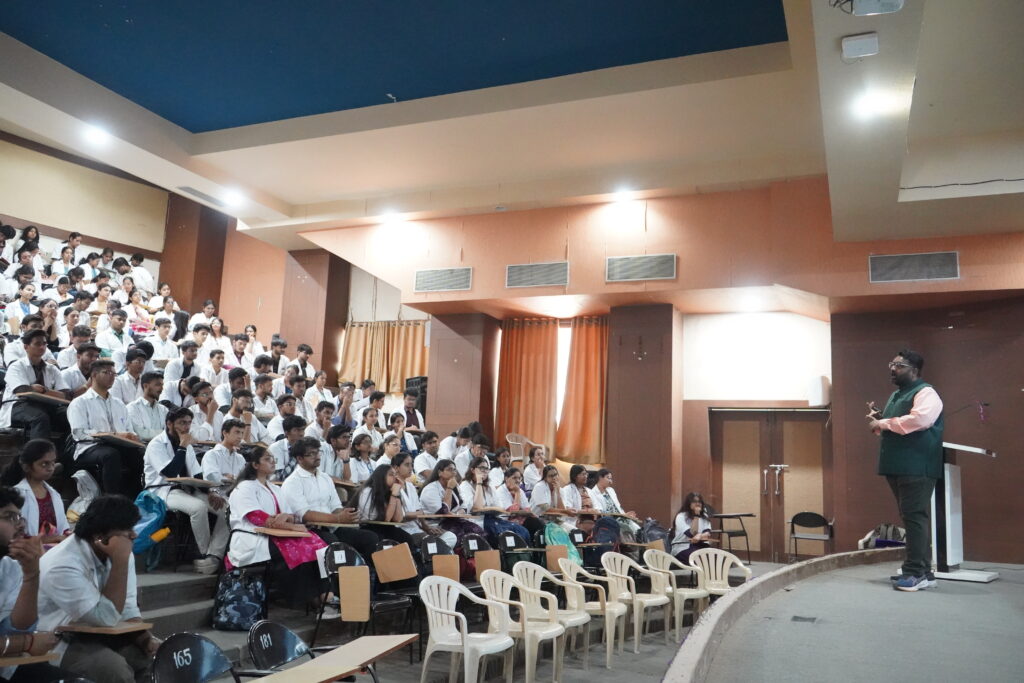
I am Chirag Khutia (CK), and I have spent 18+ years guiding over 50,000 MBBS students through this exact decision. This guide gives you the complete, unbiased picture of every career option after MBBS in India including the ones no one talks about.
This is not a sales pitch. It is the same honest framework I use in my 1:1 sessions. Read it fully before making any decision.
First: Understand What You Are Really Choosing Between
Most students think the only question is ‘NEET PG or abroad?’ But the real fork in the road has three branches:
- Continue in clinical medicine (in India or abroad)
- Move into non-clinical healthcare (research, management, pharma, public health,healthcare technology)
- Build an independent career (practice, entrepreneurship, medical content)
Every option below falls into one of these three tracks. Knowing which track suits your personality, lifestyle goals, and financial reality is step one before you pick any exam or program.
Track 1: Clinical Medicine in India
1. MD / MS via NEET PG
The most popular path. A 3-year postgraduate degree in a medical (MD) or surgical (MS) specialty.
Top MD specialties by demand: Radiodiagnosis, Dermatology, General Medicine, Paediatrics, Anaesthesiology,Psychiatry,Geriatrics.
Top MS specialties: General Surgery, Orthopaedics, Ophthalmology, ENT, Obstetrics & Gynaecology.
CK’s honest take: Competition is brutal. The gap between a ‘good seat’ and a ‘seat anywhere’ can be thousands of ranks. Before you spend 2 years preparing, be honest with yourself about your score range and what seats are actually realistic for you.
2. DNB (Diplomate of National Board)
Equivalent to MD/MS, offered through the National Board of Examinations (NBE). DNB programs run in hospitals across India, including smaller cities. Less glamorous on paper but genuinely equivalent in the eyes of most employers and international bodies.
CK’s honest take: DNB is massively underrated. If you cannot get into a top government MD seat, a DNB in a reputed hospital can give you better hands-on training than a poor-quality MD college.
3. Diploma Courses
2-year PG diplomas in specialties like Paediatrics, Psychiatry, Clinical Pathology, Anaesthesia. Lower competition than MD/MS. A practical option if you want to specialize faster and start earning sooner.
4. Fellowship Programs
Short-term (6 months to 2 years) specialty training in areas like Cardiac Critical Care, Minimal Access Surgery, Diabetology, and more. These fellowships available without requiring NEET PG, making these a practical parallel track until one clears NeetPG or USMLE/PLAB to upgrade you career. Many MBBS graduates also choose to write Royal College Examinations like MRCP, MRCS,MRCOG etc.
5. Government Medical Officer (UPSC CMS / State PSC)
If government service appeals to you, UPSC conducts the Combined Medical Services (CMS) exam for MBBS graduates. State PSCs also recruit MOs for government hospitals, health departments, railways, and defence. Offers job security, pension, allowances, and rural service opportunities.
Track 2: International Medical Career
6. USMLE — Practice in the USA
The United States Medical Licensing Examination (USMLE) has three steps and is the pathway for Indian MBBS graduates (called IMGs : International Medical Graduates) to pursue residency and practice in the USA.
The process: USMLE Step 1 → Step 2 CK → Step 2 CS (waived) → Residency Match (ERAS/NRMP) → Residency in your specialty → US medical license.
It is long (typically 3-5 years of preparation + residency) but the financial and career upside is significant. Internal Medicine, Family Medicine, Psychiatry, and Paediatrics have better IMG match rates.
CK’s honest take: USMLE is a genuine, life-changing opportunity — but it is sold dishonestly by many agents. Your Step scores, clinical rotations, LORs, and research all matter. Do not start this journey without a realistic assessment of your profile. This is exactly where a 1:1 session with me helps most.
7. PLAB — Practice in the UK
The Professional and Linguistic Assessments Board (PLAB) exam is the route to GMC registration and practicing in the UK’s NHS. PLAB 1 + PLAB 2 → GMC registration → Foundation/Junior Doctor posts.
The UK path is generally faster and less expensive than USMLE. NHS offers structured training with clear specialty progression. IELTS is required.
CK’s honest take: PLAB is a strong option for students who want a work-life balance that is better than the average Indian residency grind. The NHS culture is very different from India — be prepared for that adjustment.
8. AMC — Practice in Australia / New Zealand
The Australian Medical Council (AMC) exam pathway leads to medical registration in Australia. It involves AMC Part 1 (MCQ) and AMC Part 2 (Clinical). Competitive, but strong demand for doctors in rural Australia.
9. DHA / HAAD / SCFHS — Gulf Countries
Saudi Arabia (SCFHS), UAE (DHA/DOH), Qatar, and Bahrain all have licensing exams for foreign-trained doctors. Less competitive than USMLE/PLAB. Strong salaries, tax-free income. Popular among students who want to work abroad without the lengthy USMLE journey.
Track 3: Non-Clinical & Alternative Careers
10. Hospital Administration & Healthcare Management
An MBA in Hospital & Healthcare Management (from institutes like TISS, Symbiosis, AIIMS) combines your clinical knowledge with business leadership. Roles include hospital CEO, operations manager, health tech startup founder, healthcare consultant.
11. Clinical Research & Pharma
The pharmaceutical and CRO (Contract Research Organization) industry actively recruits MBBS graduates as Clinical Research Associates, Medical Monitors, Regulatory Affairs Officers, and Drug Safety Specialists. Companies include IQVIA, Syneos, Covance, and major pharma MNCs.
12. Medical Writing & Journalism
If you can communicate, you can build a career creating content for medical journals, pharma companies, health tech startups, medical education platforms, or as a public health communicator. Increasingly in demand, and can be done remotely.
13. Public Health (MPH)
A Master of Public Health from institutes like AIIMS, TISS, or international universities opens careers with WHO, UNICEF, Government health departments, and global NGOs. Ideal for students motivated by systems-level health impact.
14. Health Tech & Medical Entrepreneurship
Telemedicine, health AI, medical devices, diagnostics startups : India’s health tech ecosystem is growing rapidly. Your MBBS gives you domain credibility that pure engineers or MBAs lack. Many successful health tech founders are doctors.
15. Teaching & Medical Education
Becoming a faculty member at a medical college (after MD/DNB) or building an online medical education platform. With NEXT approaching, quality MBBS coaching and USMLE prep content are high-demand areas.
How to Choose: CK’s 4-Question Framework
Before picking any path, answer these four questions honestly:
- Do I genuinely want to see patients for the rest of my career? (If no, a non-clinical track may suit you better.)
- What is my realistic NExT/NEET PG rank range? (Be honest not your dream rank, your actual practice test rank.)
- Am I willing to relocate internationally, or do I want to stay in India? (Both are valid know which one you actually want.)
- What is my family’s financial runway? (Some paths need 3-5 years of investment before any income.)
Your answers to these four questions eliminate most confusion. The problem is that most students answer them based on peer pressure, family expectations, or what a coaching class salesperson told them not on honest self-reflection.
Common Mistakes MBBS Students Make (From 15 Years of Counseling)
- Choosing USMLE because a classmate did without checking your own CV profile or finances.
- Waiting to ‘decide later’ and losing 1-2 years without preparing for anything.
- Picking a specialty based on salary alone and burning out in 3 years.
- Trusting study abroad agents who earn commission they are not career counselors.
- Comparing yourself to toppers your path depends on your score, not theirs.
When Should You Book a Career Counseling Session?
You should speak to a counselor (not an agent, not a coaching class) if:
- You have more than one option in mind and cannot decide.
- Your family and your gut are pointing in different directions.
- You want a second opinion before committing to an exam or a program.
- You have already started one path (USMLE prep, MD preparation) and it is not feeling right.
- Someone is quoting you a program or consultancy fee and you want to know if it is legitimate.
At ConsultCK, our 1:1 “Hour of Clarity” session with CK gives you an unbiased, personalized career roadmap — with no commissions, no agent fees, and no conflict of interest. We do not sell you a program. We help you choose the right one for yourself.
Book your 1:1 session with CK at consultck.in/events
Frequently Asked Questions — Career After MBBS
Q: Is it mandatory to do MD/MS after MBBS?
No. MD/MS gives you specialization and higher earning potential, but it is not mandatory. Many MBBS graduates work as General Physicians, Government MOs, in pharma, hospital management, or abroad. The right path depends on your goals, not convention.
Q: Can I practice in the USA after MBBS from India?
Yes. Indian MBBS is recognized for USMLE eligibility. You will need to clear USMLE Steps 1 and 2, complete residency in the USA, and obtain state licensure. The process takes 4-8 years but is achievable with the right preparation and profile.
Q: Is PLAB easier than USMLE?
Generally yes; PLAB has fewer steps and a faster timeline. However, ‘easier’ depends on your strengths. PLAB is more clinically focused; USMLE has a heavier basic science component in Step 1. Both require serious preparation.
Q: What are the non-clinical career options after MBBS?
Hospital administration, clinical research, medical writing, pharma (regulatory affairs, drug safety), public health (MPH), health tech, medical education, and healthcare entrepreneurship are all strong non-clinical paths for MBBS graduates.
Q: How do I choose between USMLE and NEET PG?
This is the most common question I receive. The answer depends on: your NExT score range, your financial capacity, your specialty of interest, and whether you genuinely want to live and work abroad. There is no universal right answer & there is only the right answer for your specific situation.
Book a session with CK at consultck.in/events for a personalized assessment.